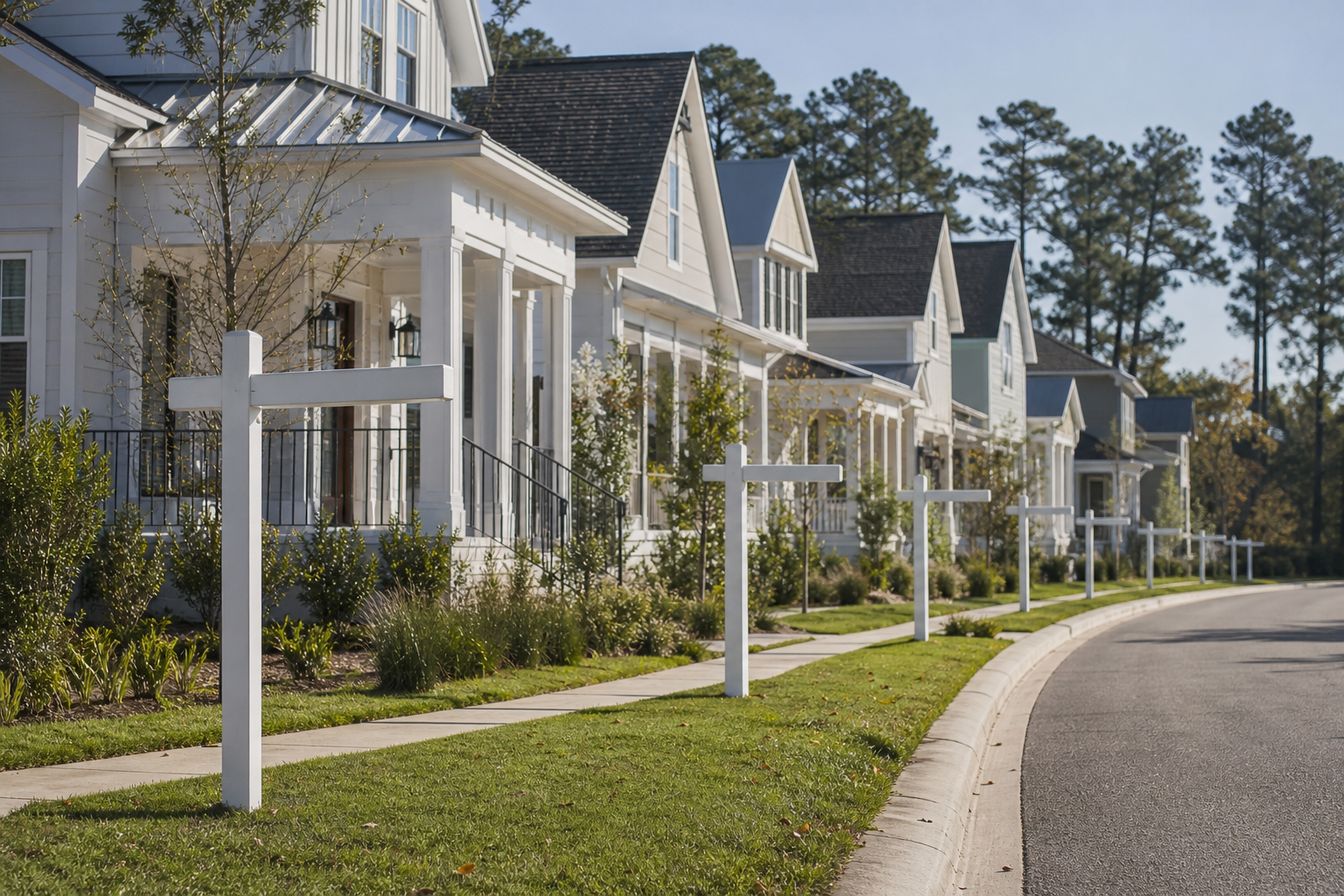

Weighing financial factors in Rosenberg communities means comparing purchase price, property-tax jurisdiction, HOA assessments, MUD charges, and amenity value together, not separately. The right community balances what you’ll actually use against what you’ll pay every month and at resale.
How do financial factors in Rosenberg communities affect what you actually pay?
The financial factors in Rosenberg communities go well beyond the purchase price. Your total monthly cost depends on which taxing entities cover your parcel, whether a municipal utility district (MUD) is layered on top, what the HOA charges and covers, and how much of the amenity package you’ll realistically use. Two homes priced identically in different communities can carry meaningfully different ongoing costs.
Key Takeaways
- The Fort Bend South/Richmond area reported a $366,319 median sold price and 6.5 months of inventory in September 2026, signaling a buyer-friendly market where community-specific details matter.
- The Fort Bend North/Richmond area reported a $455,519 median sold price and 6.1 months of inventory in September 2026, a nearly $90,000 gap from the south submarket that illustrates how much location within Fort Bend County matters.
- Rosenberg’s published FY2026 city property-tax rate is 30.00 cents per $100 of assessed value, but your total rate depends on every taxing entity tied to your specific parcel, county, school district, drainage district, and any applicable MUD.
- Amenity costs are not limited to the HOA monthly assessment, special assessments, facilities fees, MUD charges, and transfer fees can all add to the real cost of a planned community.
- With more than six months of inventory across Fort Bend submarkets, buyers have real negotiating room, which makes understanding the full financial picture before you make an offer more important than ever.
What are the real financial factors in Rosenberg communities you need to compare?
When I sit down with buyers considering Rosenberg’s planned communities, the first thing I do is separate the costs into layers. Most people focus on the purchase price and the HOA fee. Those matter, but they’re only two pieces of a larger picture.
Here’s the framework I walk every buyer through:
- Purchase price and assessed value. In Texas, ad valorem taxes are based on 100% of current market value, according to the City of Rosenberg’s tax page. That means a higher purchase price translates directly into a higher tax base.
- Property-tax jurisdiction stack. This is the one that surprises buyers most. Two communities sitting a mile apart can fall under completely different combinations of taxing entities. The city, Fort Bend County, your school district, a drainage district, and one or more MUDs can all levy separate rates. The City of Rosenberg’s FY2026 city rate is 30.00 cents per $100 of assessed value, but that’s only the city’s slice. The city’s tax page shows a combined example rate of $1.888900 per $100 for Rosenberg, Fort Bend County, Fort Bend Drainage District, and Lamar CISD. That combined figure applies to the specific entities listed and should not be assumed to apply to every parcel in the area.
- MUD charges. Many newer planned communities in and around Rosenberg are served by a municipal utility district. A MUD levies its own tax rate, carries bond obligations tied to infrastructure construction, and bills separately for water and wastewater. The relevant district, not the builder’s marketing brochure, is the authoritative source. Fort Bend County’s property-tax database is the right place to verify the entities attached to any specific address.
- HOA assessment and what it actually covers. Monthly dues vary widely between communities. More important than the number is what’s included: exterior maintenance, common-area landscaping, amenity operations, reserve contributions, or basic street lighting. A lower HOA that funds nothing meaningful may cost you more in deferred maintenance and special assessments down the road.
- Amenity access costs beyond the base assessment. Some communities charge separate recreation fees, guest fees, or facility-reservation fees on top of the monthly HOA. Transfer fees and resale-processing charges apply when you eventually sell. These are community-specific and buried in the governing documents, I always pull the current budget and the declaration before my buyers commit.
Your specific number depends on every one of these layers combined. The only way to compare communities accurately is to run the full stack for the exact parcel you’re considering, that’s exactly the kind of analysis I do with my clients before they make an offer.
How to verify your parcel’s full tax burden
The Texas Comptroller’s Fort Bend County property-tax database lets you look up any address and see every taxing entity attached to it. Do this for every community you’re seriously considering. Fort Bend County notes that tax information is updated during August and September each year as entities propose and adopt rates, so the figures you see in fall reflect the most current adopted rates.
School-district taxes are often the largest single line item in the total rate. Rosenberg-area communities can be assigned to different districts, and that assignment is parcel-specific, not community-wide. Confirm the exact district for the address you’re buying, not just the community’s general marketing materials.
How do amenities affect the financial picture in Rosenberg planned communities?
Amenities are a genuine financial factor, both as a cost driver and as a resale consideration. The question is whether the amenity package you’re paying for is one you’ll actually use.
A community pool, fitness center, splash pad, trail system, lake, or clubhouse adds real value when your household will use it regularly. It adds less value, and still costs money, when it sits unused. Before you assign value to an amenity, check the operating hours, access rules, guest limits, age restrictions, and the maintenance condition. A resort-style amenity center that’s been deferred on capital projects is a liability, not an asset.
On the resale side, the September 2026 HAR data for Fort Bend County is worth understanding. The Fort Bend South/Richmond submarket reported 6.5 months of inventory and 60.7 average days on market. The Fort Bend North/Richmond submarket reported 6.1 months and 58.2 days on market. Both submarkets are sitting above six months, which is generally considered a buyer’s market. That context matters for resale: when buyers have meaningful choice, a home’s community-specific advantages, condition, floor plan, tax profile, HOA services, and amenity quality, carry more weight than amenities alone.
Greater Houston single-family sales declined 11.5% year over year in August 2026, with a regional median around $330,000. Rosenberg-area communities are outperforming that metro median in both submarkets, but the inventory levels mean sellers in amenity-rich communities need every advantage they can get.
If you’re thinking about resale value more broadly, the factors that drive a home’s price in this area go beyond the amenity package. I’ve written about those in detail in 5 Things That Affect Your Home’s Value in Richmond and Rosenberg, TX.
A practical comparison worksheet
When I’m helping buyers compare two or three communities side by side, I use a simple worksheet. Here’s the structure:
| Factor to Compare | Why It Matters | Where to Verify |
|---|---|---|
| Purchase price and assessed value | Sets your tax base at 100% of market value | Sales contract, FBCAD appraisal record |
| All taxing entities (city, county, school, MUD, drainage) | Determines total annual property-tax bill | Fort Bend County tax database, parcel-specific |
| HOA monthly assessment and what it includes | Recurring cost; scope varies widely | HOA governing documents and current budget |
| MUD tax rate and bond status | Separate levy; declines as bonds pay off | MUD district directly, not builder materials |
| Amenity access rules and condition | Determines real vs. marketed value | Community visit, HOA budget, capital reserve plan |
| Transfer fees and resale charges | Affects net proceeds when you sell | HOA declaration and resale certificate |
| Flood-risk information | Affects insurance cost and resale | FEMA flood map, lender disclosure |
Filling this out for each community you’re seriously considering takes the guesswork out of the comparison. Every situation is different, and the only way to know which community pencils out best for your household is to run the actual numbers, that’s where I come in.
If you’re still getting oriented on what’s available in the area, New Master-Planned Communities in Richmond and Rosenberg TX is a good starting point for understanding what’s been built out recently.
Frequently Asked Questions
Do MUD taxes make a Rosenberg community more expensive than one inside the city limits?
A MUD-served community can carry a higher total tax rate than a city-served one, but it depends entirely on the specific MUD’s adopted rate and bond obligations. MUD rates typically decline over time as infrastructure bonds are paid down. The only way to compare accurately is to look up the taxing entities for the exact parcel through the Fort Bend County property-tax database, community-wide generalizations won’t give you a reliable answer.
How much do HOA fees differ between Rosenberg communities?
HOA assessments vary significantly depending on the amenity package, the size of the common areas, and how much the community funds its capital reserves. A community with a resort-style amenity center, lakes, and maintained trails will generally carry higher dues than one with minimal common amenities. Beyond the monthly number, review the current budget and reserve-fund status, an underfunded reserve is a sign that a special assessment may be coming.
Are amenity-rich homes in Rosenberg easier to resell?
Amenities can support resale value, but they’re not a guarantee in the current market. The September 2026 HAR data shows more than six months of inventory across Fort Bend County submarkets, which means buyers have real choices. A home in a well-maintained community with a strong amenity package, a competitive tax profile, and good condition will outperform one that relies on amenities alone. Resale strength comes from the full picture.
How should I compare property taxes before buying in Rosenberg?
Look up the exact parcel address in the Fort Bend County property-tax database and identify every taxing entity, city, county, school district, drainage district, and any MUD. The City of Rosenberg’s tax page provides a combined example rate, but it applies only to the entities listed there and shouldn’t be assumed to cover every property in the area. Rates are updated during August and September each year, so fall is a good time to verify current adopted rates.
What should I check in an HOA budget before buying in a planned community?
Start with the reserve-fund balance relative to the reserve study’s recommended funding level, an underfunded reserve often leads to special assessments. Then confirm what the monthly assessment actually covers (amenity operations, landscaping, insurance on common areas), whether there are separate recreation or facility fees, and what the transfer and resale-processing charges are. The governing documents and the most recent audited financials are the authoritative sources, not the builder’s sales sheet.
Weighing the financial factors in Rosenberg communities is genuinely complex, there are more moving parts than most buyers expect going in. The purchase price is just the starting point. I help my clients build out the full cost picture, community by community, so the decision is based on real numbers rather than marketing materials.
Ready to compare communities side by side? Schedule a consultation or get a market price opinion to start with a clear picture of where you stand. You can also reach me directly at 832-220-1461.
About Amanda Dockum
Amanda Dockum is the Managing Broker of Crimson Realty, serving the Greater Houston area with a focus on Fort Bend, Montgomery, and Harris Counties. She and her team specialize in helping first-time buyers and first-time sellers navigate the real estate process with confidence, with deep expertise in master-planned communities across Magnolia, Richmond, and Rosenberg, TX.
Crimson Realty · 832-220-1461
Equal Housing Opportunity. This article is general information only and is not legal, tax, or financial advice. Confirm your specific numbers with your title company, tax advisor, or lender. Amanda Dockum is a licensed real estate broker in Texas; no license number is required on advertising under TREC rules. Regulated by the Texas Real Estate Commission (TREC).